When it was normal to swim without a swimsuit
Published on 17 November 2026
Perhaps not everyone knows this, but the habit of wearing a swimsuit at the beach and in the pool is relatively recent. From Ancient Rome to muscular Christianity, passing through the German FKK, it was customary—mostly for men—to swim without clothes. And this custom persisted in the United States until at least the 1970s, when pool nudity was mandatory for hygienic reasons.
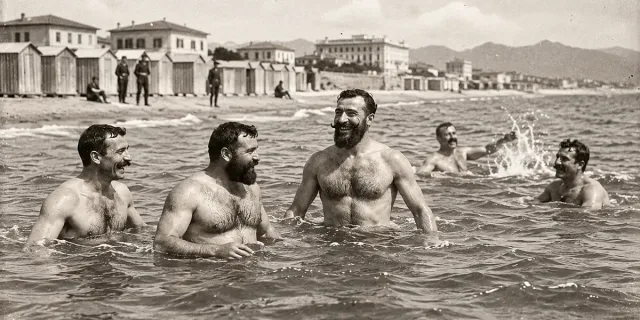
It may seem hard to believe, but the habit of wearing a swimsuit is relatively recent. In fact, not everyone knows that for centuries, and in some nations at least until the 1970s, swimming nude was the norm both at the sea and in the pool. At least for men who, depending on historical eras, were able to enjoy nudity without too many limitations, sometimes for social reasons, others to show off their virility, and others still for purely hygienic matters. The evolution for women was different, as despite a certain freedom granted in the Roman era, they were progressively subjected to increasingly limiting modesty.
From Ancient Rome to the Middle Ages: nudity as a social value
It is certainly no secret: in Roman baths, nudity was the rule. For a large part of the Roman Empire, social nudity equally involved men and women, who gathered in the numerous baths of the time to share moments of relaxation and well-being. Not surprisingly, the baths were also considered the perfect place to discuss business. However, according to the Historia Augusta, it was Emperor Hadrian who imposed the separation of baths between men and women, perhaps in order to limit excessive promiscuity.
Even in the Middle Ages, despite greater moral and religious rigidity, the practice of swimming without clothes found spaces to survive. The most famous testimony dates back to 1416: the Florentine humanist Poggio Bracciolini, passing through Baden during the Council of Constance, wrote a letter to his friend Niccolò Niccoli describing a veritable paradise, probably a thermal center, where men and women immersed themselves naked together in large tubs, without apparent malice.
Historians do not all agree on the actual nudity: some speak of complete nudity, as was traditional for baths of northern and Teutonic origin, others of light veils. In any case, both in the times of Ancient Rome and during the Middle Ages, nudity had a very different meaning from the current one:
- baths were social places where people not only washed and swam, but also ate, danced, and forged friendships and business relationships;
- the baths had a medical function, water was seen as a cure, and therefore nudity was considered functional to well-being.
Between the 19th and early 20th century: the praise of the male naked body
If one could use a time machine to transport themselves back just over a century ago, they would find European beaches completely filled with naked men. In the 19th century, sea bathing became a fashion, albeit with a marked distinction between the male and female genders. While men were allowed to show off their bodies in various situations—though with high differences based on social class: nudity mainly concerned the lower-middle classes and dock workers, while professionals and nobles tended to wear heavy tank-top swimsuits—women were required to be much more modest. In fact, they were not used to frequenting beaches known for the presence of naked men and, even when on textile shores, they had to remain on the beach in conspicuous and bulky clothing, leaving little more than their faces and hands exposed to the sun.
After all, the male body was the cornerstone of a very precise ideology that centered on the concepts of strength and virility. Suffice it to think of muscular Christianity, the philosophical and religious movement born in England in the mid-19th century, which united Christian faith with physical culture, athleticism, and the ideal of an active and vigorous masculinity. Going to the sea, or exercising in the pool, meant showing off one's body, completely rejecting the idea that such perfection could be covered by garments. Not surprisingly, the shift toward more modest swimming was accompanied by conspicuous protests: the Reverend Francis Kilvert, an English Anglican pastor, complained publicly in 1874 about the new rules introduced in Shankin, on the Isle of Wight, reporting that the necessity of bathing in trunks was "hateful" to say the least. He even added, with a touch of irony, that "if ladies do not like to see naked men, let them stay at home".
Even when there was no coordinated political-religious ideology, the male body was still considered a symbol of strength to be flaunted. Among the less affluent classes, young men had been introduced to clothing-free maritime conviviality alongside men of all ages since adolescence. In some nations, the concept of physical strength prevailed, with nudity serving to highlight musculature, while in others virility did, praising massive, hairy bodies toughened by the harshness of life and hard work.
Even in countries like Italy, France, and Spain, the naked male body on the beach remained the rule at least until the 1920s, although not driven by particular ideologies, but rather by practicality or—for a considerable portion of the less affluent population—simple poverty. In the upper social classes, nudity was instead beginning to become a symbol of an eclectic and non-conformist life: for example, the famous shots capturing Gabriele D'Annunzio without clothes on the beach are well known. In Italy in particular, it is worth remembering that the habit of wearing a swimsuit spread among men mostly during the fascist era.
The birth of the German FKK
And it is precisely during this period that the German FKK was born, today a synonym for nudism and naturism worldwide. Freikörperkultur, meaning the "free body culture", developed within the Lebensreform movement—or "life reform" of the late nineteenth century. The first official club was founded in Essen in 1898, and after the First World War, the first German nudist beach was established in Sylt in 1920.
However, the FKK followed a different path from the rest of Europe. Not only was there no such sharp demarcation between women and men, but the underlying idea was that the naked body was not a reason for shame, considering how contact with the sun and nature was good for health. Thus, gyms, sports centers, swimming pools, and much more were born, where nudism was practiced without any kind of moral misgivings. With the rise to power of Nazism, nudist and naturist associations were heavily restricted, but the movement resumed with greater vigor at the end of the Second World War.
Nude in the pool: the norm in the USA until the 1970s
To find the most recent case, however, one must go across the Atlantic to the United States. At least until the 1970s, men in public and school pools were required to be completely naked. Despite what one might think, the reason was hygienic. The American Public Health Association had indeed issued guidelines requiring complete male nudity, and light, very simple swimsuits for women, in order to preserve healthfulness in pools:
- at least until the 1940s, and in some areas until the 1960s, swimsuits were predominantly made of wool or cotton, which released many fibers during swimming that were ready to clog the filtration systems of the pools;
- in schools, swimming instructors and coaches were instead required to visually inspect students before diving into the pool to identify skin infections, irritations, lice, or other parasites. This was because the water sanitization technologies of the time did not always allow for total sterilization, so upstream control promised to reduce the risks of contamination.
The habit changed radically both with the increasing spread of synthetic swimsuits, which guaranteed rapid drying and greater hygiene, and with the shift in direction by the YMCA. When they began admitting girls in the 1970s, they made swimsuits mandatory.